
Fundamentals & Science

The amount of pressure you're under depends on where you live. I live in Florida, so I'm very close to sea level. Therefore, the weight of the atmosphere is exerting exactly 14.7 pounds per square inch (PSIA) of pressure on every surface in every direction. There is no such thing as negative pressure—only pressure lower […]
Read more
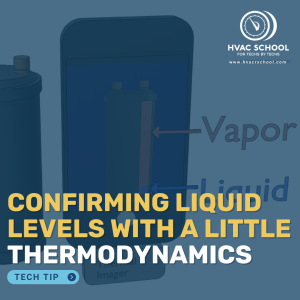
Maintaining the correct vapor-liquid refrigerant balance is crucial for air conditioning and refrigeration system performance. Longer line sets hold more refrigerant, which increases the risk of liquid accumulating in the suction line or entering the compressor during off-cycles. Heat pumps are one common application that requires additional measures. Refrigerant flow reverses during heating, turning the […]
Read more
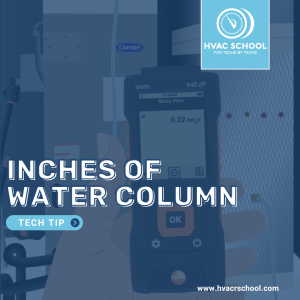
Low pressures are often measured in inches of water column or “WC. Like most units of measure, it has a very simple origin; in a water manometer, 1″ of water column is literally the amount of force it takes to raise the column of water by 1”. While some water manometers (water tubes) are still […]
Read more
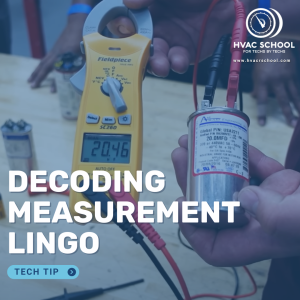
Troubleshooting and commissioning are entirely data-dependent processes. How can you know that a system is undercharged unless you measure the superheat and subcooling? How can you know how much static pressure a blower motor has to overcome? In both cases, we use tools and measurements to help us determine the next steps. However, using the […]
Read more

So, what is thermometry anyway? Thermometry is the scientific study of measuring temperature and has roots that date back to as early as 220 BC. During this time, Philo of Byzantium began to study the effects that temperature had on air. Specifically, he observed expansion and contraction caused by temperature change. He did this using […]
Read more

If you went to school and learned the “gas laws” early on, you probably thought it seemed LAME. Then, later, things like mass flow rates, airflow conversions, and compression ratios seemed HARD. Well… It's because HVAC is hard if you don't understand the concepts behind the gas laws, even if you never learn to do […]
Read more
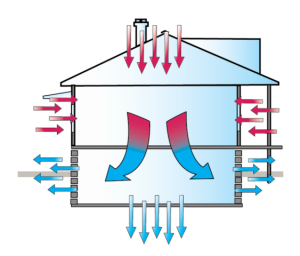
We've all heard some version of the phrase “heat rises,” but is that really true? First, we need to remember that heat is energy, not matter. Heat is a force, not a thing. So, while heat may result in changes to matter (stuff), it isn't matter itself. When we add heat to stuff, the molecules […]
Read more

When someone says there is no such thing as “cold,” only the absence of heat, you can point out that while cold is the absence of heat… absolute zero is the definition of COLD. The third law of thermodynamics addresses the absence of heat and what that means for entropy. It implies that absolute zero […]
Read more

The second law of thermodynamics puts the first law into context and establishes entropy as a concept. We can simply define entropy as a state of disorder that can only increase or remain the same in natural processes. Processes in which entropy remains the same are reversible, but ones that result in an entropy […]
Read more